Sebastein Haller is now the All-time African Top scorer of the champions league group stage(9).
Sebastein Haller has now scored nine goals in the group stage of the Uefa Champions league this season. The most by an African player in a single edition of the tournament. The Ivorian is the top-joint scorer of this years edition with Lewandoski 9 .The striker is also the Top scorer for eredivise side Ajax Amsterdam this season.
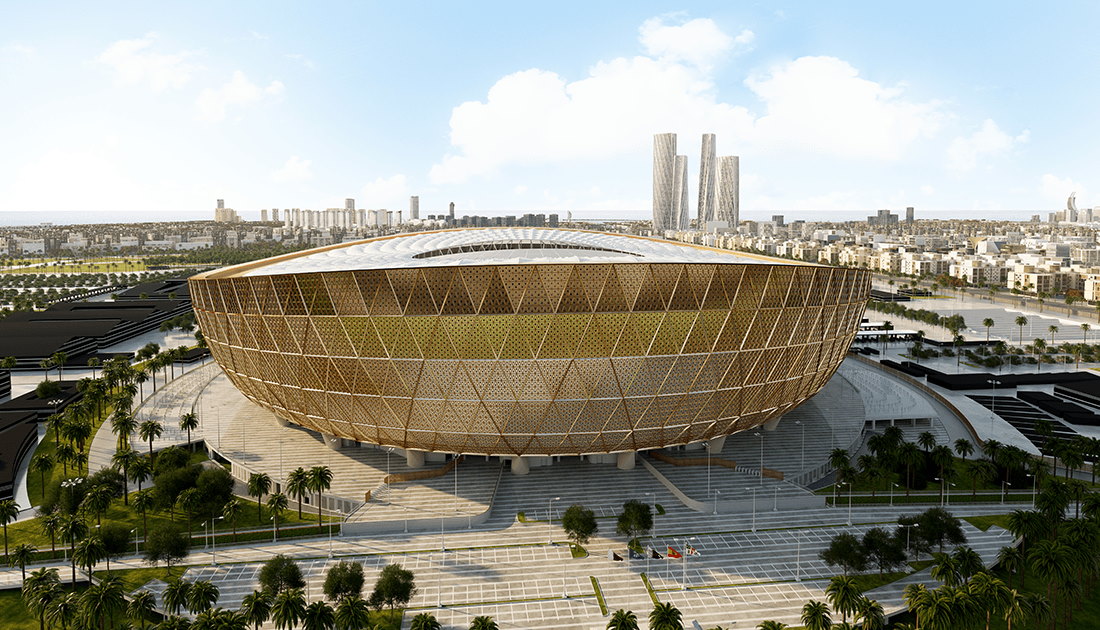
Construction has now completed on Lusail Stadium, which was designed by British studio Foster + Partners and will host the final game of the 2022 FIFA World Cup.
With Lusail, the largest and final venue for the World Cup now finished and set to be inaugurated next year, Dezeen has rounded up all eight realised stadiums for the 2022 FIFA World Cup in Qatar.
The sporting event takes place from November to December 2022 and will be the first World Cup to be held in the Middle East and Arab world.
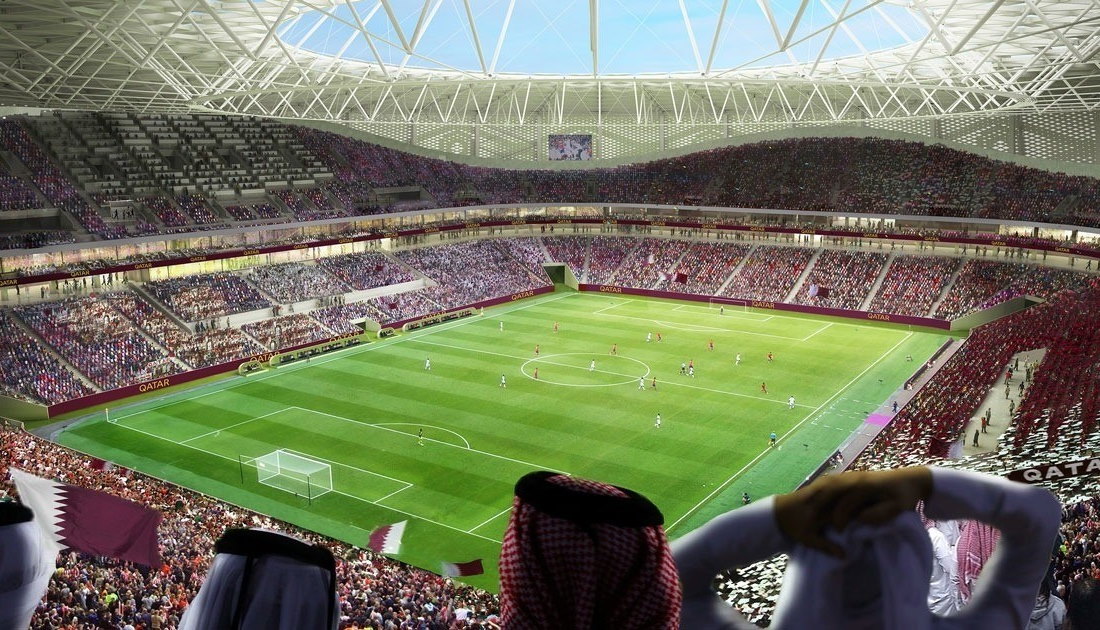
The aptly named Lusail Stadium is located in Lusail City and is Qatar’s largest 2022 FIFA World Cup venue. The stadium will seat 80,000 people and host both the opening and closing of the 2022 football tournament.
Its design by Foster + Partners was informed by and references Arab architecture, reflecting the decorative designs on Arab and Islamic bowls and vessels.
Lusail City, where the stadium is located, is a “futuristic” new city that will be home to 250,000 people and is located 20 kilometres from Doha.
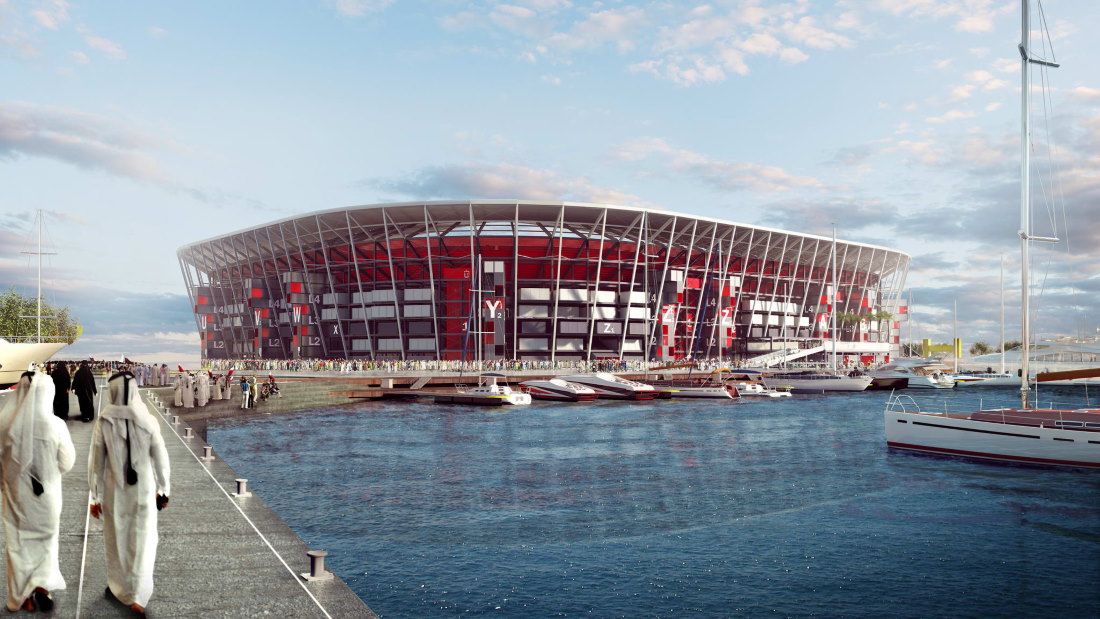
Constructed using modified shipping containers, Stadium 974 was designed by Spanish architecture practice Fenwick-Iribarren Architects.
974 repurposed steel shipping containers will be arranged in a curving square to house 40,000 seats. The stadium will be the first fully demountable stadium in FIFA World Cup history.
Located in Ras Abu Aboud, it will host matches up to and including the round of 16 during the World Cup.
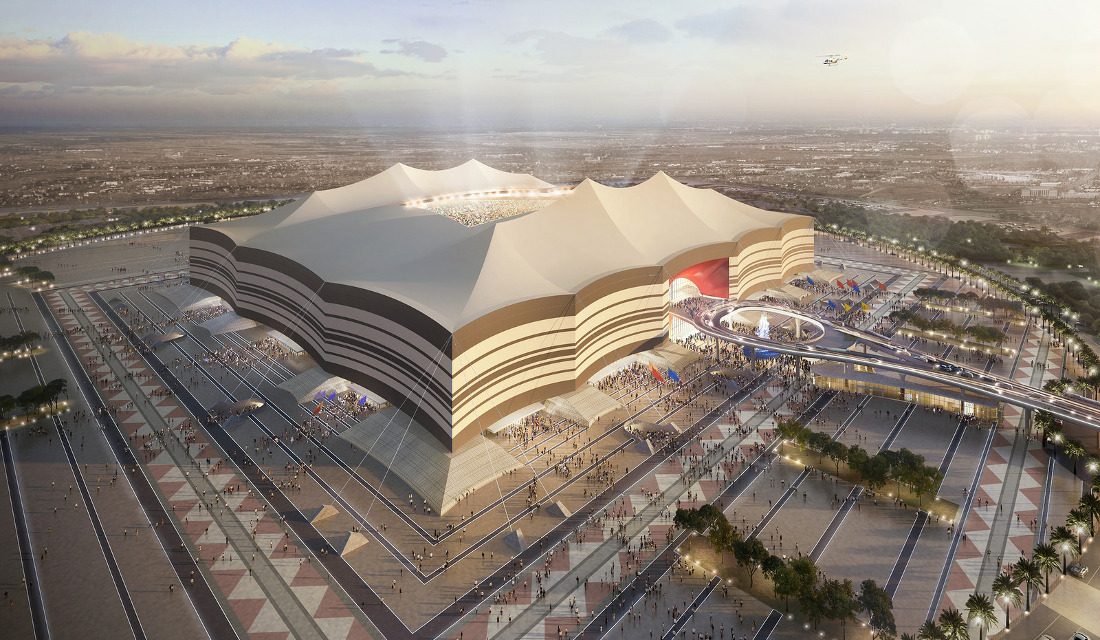
Informed by ‘bayt al sha’ar’, tents historically used by nomadic people in Qatar and the Gulf region, the Al Bayt Stadium by Dar Al-Handasah celebrates the history of Qatar and its people.
Its tent-like design has a retractable roof system that will shade the structure and work with the cooling systems to cool the stadium internally. The stadium was opened in 2020 and will host 60,000 people during the football tournaments.
The stadium will host matches up to and including the semi-finals and after the tournament, 28,000 seats will be donated to developing countries.
Qatari architect Ibrahim M Jaidah modelled the Al Thumama Stadium in Doha after the gahfiya, a traditional woven cap worn by men throughout the Middle East.
The stadium has a 40,000-person capacity in its large concrete bowl. After the tournament has ended, 20,000 seats from the upper stand will be removed and replaced by a 60-room boutique hotel.
Al Thumama Stadium will host matches up to and including the quarter-finals stage of the tournament.
Built on the site of the former Ahmad Bin Ali Stadium, the stadium by Pattern Design and Ramboll used materials from the deconstructed stadium within the new structure.
The stadium is clad in multimedia screens that glow and change colours. These are enveloped by a metal screen that depicts patterns and motifs typically found across Qatari architecture.
Its design was inspired by sand dunes and Islamic architecture, and the building will host matches up to and including the round of 16.
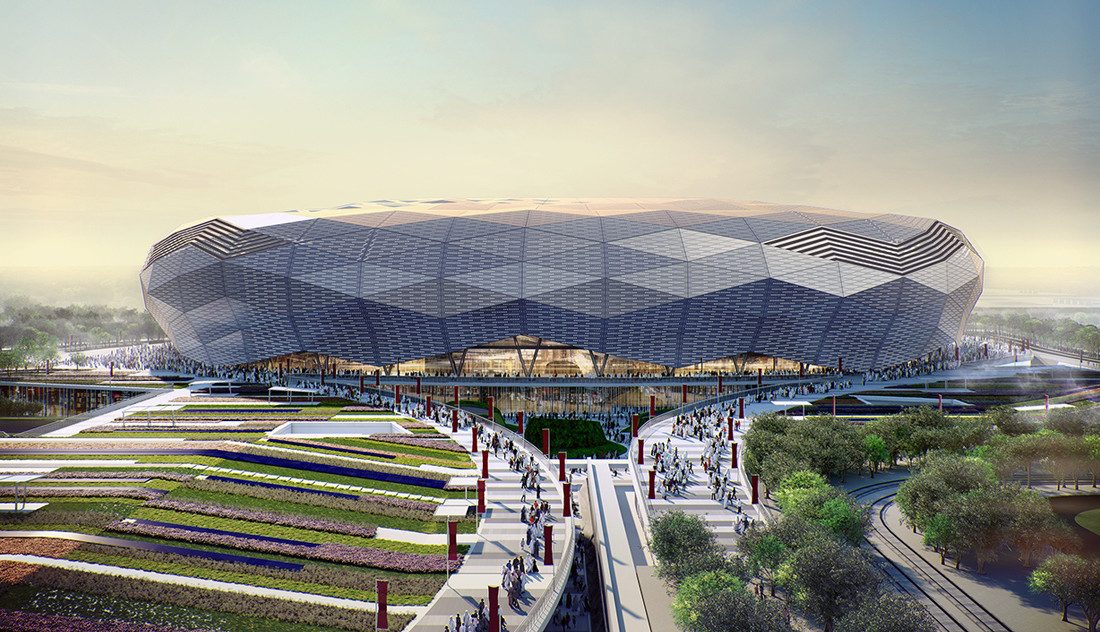
Colloquially known as the “Diamond in the Desert”, Fenwick-Iribarren Architects and Pattern Design’s Education City Stadium has a tessellating, geometric facade that changes colours as the sun hits its surface.
The stadium was the first of Qatar’s 2022 tournament stadiums to be awarded a five-star rating for sustainability from the Global Sustainability Assessment System.
It will host matches up to and including the quarter finals stage and be home to Qatar’s women’s national team and two schools after the World Cup is over.
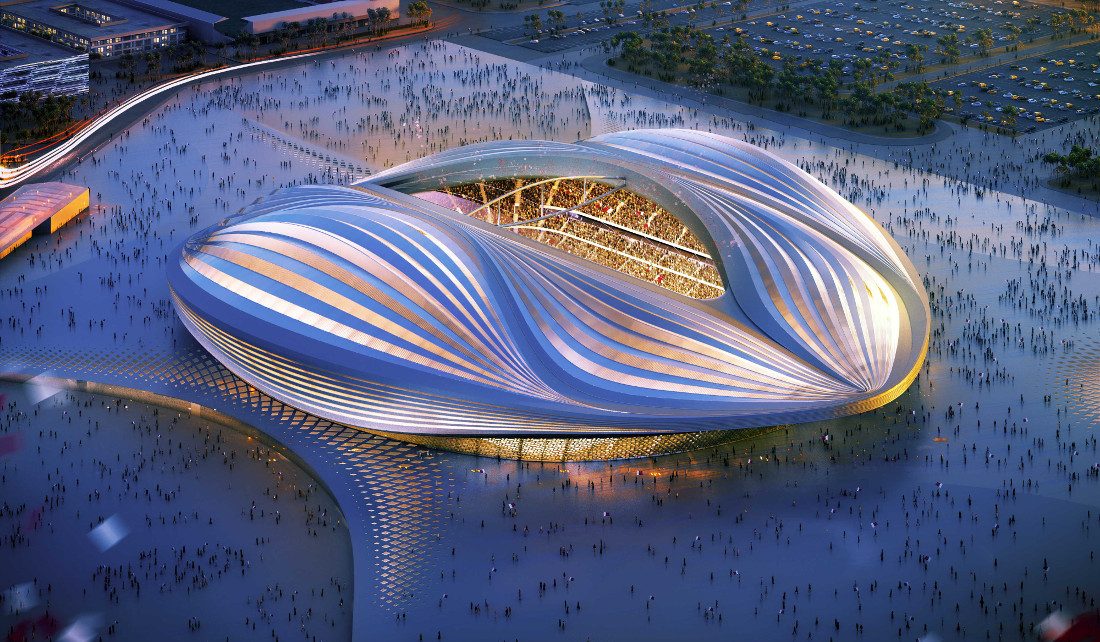
The Al Janoub Stadium by AECOM and Zaha Hadid Architects was the first of the Qatar 2022 stadium’s to be completed. It is located 10 miles south of Doha and is host to 40,000 seats.
The design was informed by the sails of the traditional dhow fishing boats found in the city’s harbour, as a tribute to Al Wakrah’s seagoing history. The stadium was also built with cooling systems and a retractable roof.
Al Janoub Stadium will host matches up to and including the round of 16.
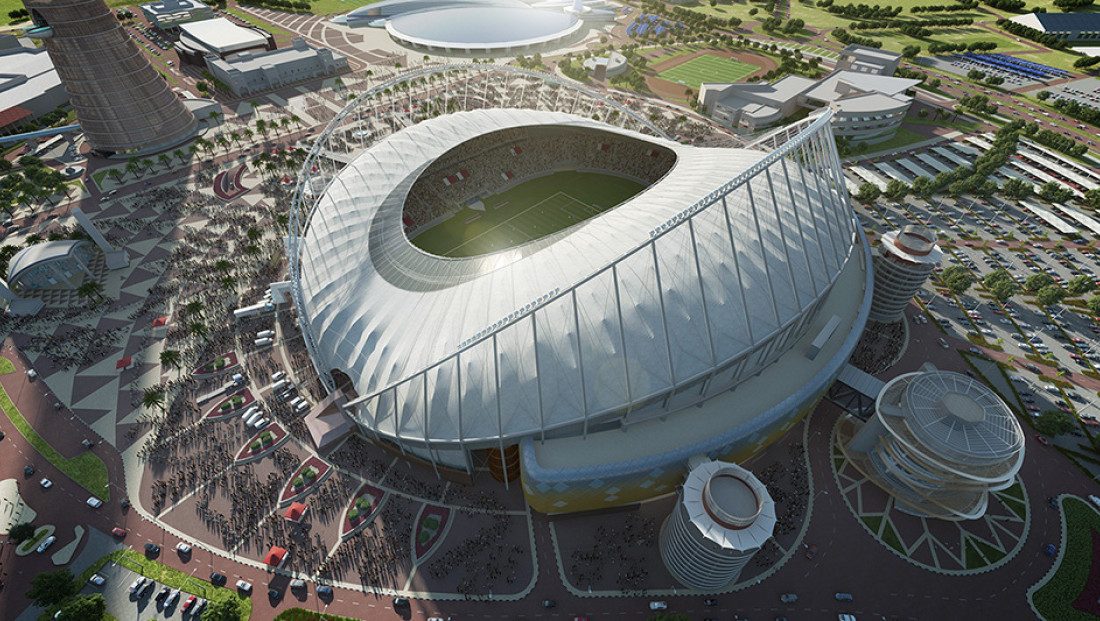
The Khalifa International Stadium was renovated and redeveloped in the lead to the FIFA World Cup 2022. It was updated with a new tier of seating, adding 12,000 seats, as well as a new facade.
The structure has hosted a variety of sporting events since it first opened in 1975 and has since served as Qatar’s national stadium.
It was the first stadium to be ready for the tournament and will host matches up to and including the third-place play-off.
Average venue capacity: 47,500 seats Largest venue: Lusail Stadium (80,000 seats) Smallest venue: Multiple venues (40,000 seats) Average no. of matches per venue: 8.1https://www.google.com/maps/d/u/0/embed?mid=1co6eskScO9IDVmcEoE8inOyN8sQ
Lusail
Lusail Stadium | Capacity: 80,000 seats | Opening: 2021 | Status: under construction
Matches:
5x Group Matches 1x Round of 16 1x Quarter-Final 1x Semi-Final Final
Chelsea demolished Juventus in London by 4 goals, currently Chelsea sit on top of both Epl and Ucl (group G) Chelsea have conceded the least goals in Europes Top 5 leagues.
This time, they have breezed into the knock-out stages with a game to spare, having inflicted Juve’s heaviest ever Champions League defeat, demolished their goal difference and taken a grip on Group H. Confidence is soaring.
There were goals to enjoy from three academy graduates Trevoh Chalobah, Reece James and Callum Hudson-Odoi before Werner came on to find the net on his return from injury, a sweeping move featuring a sumptuous cross-field pass from James and low cross from Hakim Ziyech.
The Italians, long acclaimed as Europe’s master defenders were in tatters, and there was no need to risk Romelu Lukaku, who watched from the bench with his feet up. All in all, an ideal way to prepare for the visit of Manchester United on Sunday.
The night was only marred slightly by knee injuries to Ben Chilwell and N’Golo Kante, but Tuchel’s versatile Chelsea team keep finding new ways to impress. No Lukaku, no Werner, no problem. No Kai Havertz, out with tight hamstrings, no problem.
Who needs strikers when the defenders are scoring at will and not letting goals in either? This was Tuchel’s 50th game in charge and his 31st clean sheet, and, at the moment, his every move pays dividends.
After a pedestrian performance against Juventus in Turin in September, the German hoped the pace and mobility of Christian Pulisic, starting for the first time since the opening game of the Premier League season against Crystal Palace, might link up with the craft of Ziyech and trickery of Hudson-Odoi.
There was energy and urgency about Chelsea from the opening moments when Kante cut through the black-and-white shirts and into the penalty box, where both Hudson-Odoi and Chilwell swung at shots without connecting.
His wing-backs were high and the ball zipped through the midfield and piled pressure on Wojciech Szczesny, the former Arsenal goalkeeper once on the end of a 6-0 hammering at Stamford Bridge.
Chelsea found the breakthrough, from a set piece. A corner delivered by Ziyech, clipped Adrien Rabiot, clattered into Antonio Rudiger and fell to Chalobah, who swept it confidently into the net on the half-volley.
Bonucci led the protests, claiming he was fouled by Jorginho. The Juventus captain seemed to have a case. The ball also struck Rudiger on a hand but the Serbian officials and the Spanish VARs checked the replays and let it stand. Chelsea led and Chalobah had his fourth goal of the season, drawing him level with Lukaku.
Juventus offered little threat in the first half. They have made a spluttering start to the season in Italy but have impressed in Europe, taking maximum points from their first four game, beating Chelsea in Italy, and were sure to qualifying before they arrived in London.



 Ifordepeople